
I. Purpose & Scope
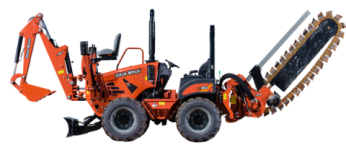
To safely and effectively provide instruction on the inspection and proper use of trenchers.
II. Definitions
Standard PPE – High Viz Garment, Hard Hat, Z-87.1 Safety Glasses, Gloves, Pants, Work Boots
III. Process
NOTE: Work instruction does not supplement the manual. For specific instructions for the exact model please refer to the owner’s manual.
A. Potential Hazards
- Moving Parts Hazard
- Electric Shock Hazard
- Deadly Gases Hazard
- Crushing Weight Hazard
- Fire and Explosion Hazard
- Fall Hazard
- Rollover Hazard
- Pressurized Fluid Hazard
- Burn Hazard
- Flying Objects Hazard
- Noise Hazard
B. PPE
- Standard PPE
- Hearing Protection
C. Inspection
- Check emergency engine stop.
- Turn ignition switch to the on position but do not start engine.
- Press an emergency stop button.
- Repeat process for each emergency stop button.
- Check engine oil level.
- Ensure that engine oil level is correct and inspect for contamination such as oil discoloration or water in the oil.
- Change oil and filter if contaminants are present.
- Check engine coolant level and ensure that level is at the maximum level and inspect for signs of contamination.
- Check air filter light.
- The main filter can be cleaned up to six times before replacing.
- The secondary filter must not be reused.
- Check hydraulic fluid level.
- If the fluid level is not visible through the sight glass then add fluid at fill until fluid can be seen through the sight glass.
- The fluid level must be checked with fluid is cold.
- Lock the tank plug after each refilling.
- Check hydraulic hoses condition and replace those that appear damaged.
- Check gearboxes and pump drive.
- Inspect the flywheel gearbox, the two track gearboxes and the engine pump drive to spot possible leakages.
- The flywheel gearbox cases and the pump drive cases are all equipped with an air vent, oil level tank plug and drain plug.
- The track gearboxes are equipped with oil level tank plug and drain plug for inspection. Rotate the gearbox until the oil drain plug is in the lowest position.
- Fill all gearboxes to indicated level with MPL.
- Check nuts and bolts and ensure there are no looses fasteners. If any fasteners are loose, tighten them to the correct torque specifications.
- Check and adjust conveyor belts. Ensure that belt is not excessively worn and is set at the proper tension. Allow for material load to increase tension.
- Check hydraulic cylinder rods are not nicked or damaged and that they do not show signs of oil leakage. Clean and ream, if necessary.
- Check tail roller does not show excessive wear signs and that the bearings do not have any backlash. Also make sure that the seals do not leak. For fills, unscrew the end cap venter port.
- Check digging chain for excessive wear and proper tension.
- Check digging teeth. Replace teeth when the carbide tip:
- Splinters or breaks
- Rounds, flattens or becomes square
- Is broken or not functioning properly
- Check chain baseplates and toothstops, and check plate nuts and screws for tightness.
- Check boom and wearplates for wear.
- Check chain sprocket is not damaged or exceedingly worn. Replace or rotate the sprocket if the other side is not worn.
- Check the track chain to make sure that it is suitably tightened. To adjust, use the tensioner located on the undercarriage external sides.
D. Use
Lifting
- Lifting points are identified by lifting decals. Lifting at other points is unsafe and can damage machinery.
- Tie-down points are identified by tiedown decals. Securing to trailer at other points is unsafe and can damage machinery.
- Attach chains at front and rear tiedown points on each side. Make sure chains are tight before transporting unit. Lower boom and tie down.
Start Unit
- Fasten and adjust seat belt.
- Check that all controls are in neutral before starting.
- Check that the parking brake is engaged.
- Move throttle to minimum position.
- Turn ignition switch to the run position (key on, engine off). Cold start wait indicator will light.
- When cold start wait for indicator light to go off, turn ignition switch all the way clockwise to start tractor. Warning alarm will sound Indicators will light.
- Run engine at half-throttle or less for five minutes before operating tractor. During warm-up, check that all controls work properly.
Drive Unit
- Verify that parking brake is disengaged.
- Adjust throttle to about half way.
- Adjust boom lift switch to raise boom.
- Adjust the direction control lever to move unit forward or backward.
- Adjust steering control lever to adjust the direction.
- Change engine speed with throttle.
Shut Down Unit
- Move direction control levers to the neutral position.
- Lower boom to ground.
- Engage parking brake.
- Reduce engine speed to a minimum.
- Wait five minutes for engine to cool down.
- Turn ignition switch to STOP.
- Turn off the air condition and lights, if on.
- If leaving the machine unattended, remove key and lock the following:
- Cab window
- Door
- Engine compartment doors
- Tool compartment door
- Tank locking caps
Operation
- Fasten and adjust seatbelt.
- Start tractor.
- Drive to starting point. Move in line with planned trench.
- Push throttle to low.
- Lower boom to just above ground.
- Engage parking brake.
- Select the desired direction and position for conveyors to run and operate them at a moderate speed.
- Lift the trench cleaner completely.
- Place the chain operation control in the forward direction (or digging direction) at the desired speed.
- Slowly lower the digging boom taking care not to stall the digging chain.
- Release the parking brake.
- Adjust the direction control lever to move the machine forward.
- Ensure that the pressure valves on the chain and track circuit pressure gauges do not exceed the maximum values.
- After digging enough space for the trench cleaner, lower it.
NOTE: When digging on slopes, it might be necessary to set the parking brake until the trencher reaches the desired digging depth. Under such circumstances, release the parking brake before operating the direction control. - Operate engine at full throttle under load for most productive trenching. If soil conditions permit, operating in this range gives longer engine life and more efficient use of available engine power.
- If an object becomes lodged in the digging chain:
- Move speed/direction control to neutral.
- Raise boom slightly to clear bottom of trench.
- Move speed/direction control to reverse.
- Chain should reverse and release object.
- If a turn is necessary, a shorter turn may be made with the digging boom at fully depth. Take care to prevent excessive side load.
- When cutting across asphalt roads, start trench in soil at the edge of the road and dig trench with shortest possible boom at full depth.
- If leaving the machine unattended, remove key and lock the following:
- Cab window
- Door
- Engine compartment doors
- Tool compartment door
- Tank locking caps
Emergency Engine Stop
- To stop machine immediately, press button.
- To release the stop function, the button must be pulled “out” or twisted clockwise to the “out” position. The switches must be reset in order for the engine to start.
- Do not use emergency engine stop to stop engine on regular basis.
Adjust Digging Chain Tension
- Loosen (by one turn) the twelve screws that keep the gibs in place below the digging boom on both sides.
- Loosen (by one turn) the twelve screws that hold the gibs sideways.
- Loosen (by one turn) the twelve screws that fasten the digging boom on both sides.
- Clean and lube the four tightening screws and loosen the four locknuts.
- Adjust the chain tension by tightening the four tightening screws when necessary.
- Insert one or two shims when the screw travel is not enough to adjust the tension.
- Remove the boom screws when slot length too tight and reinsert.
- After achieving the proper tension, tighten the twelve screws that keep the gib in place from below; start from the external screws.
- Tighten the twelve screws that keep the gibs in place below the digging boom.
- Tighten the twelve screws that hold the gibs sideways.
- Tighten the twelve screws that fasten the digging boom on both sides.
- Tighten and lock the four tensioning screws with their four locknuts.
- Check that the twelve screws that keep the gibs in place form below are all properly tightened.
E. Maintenance
- Spray water onto equipment to remove dirt and mud.
- Make sure all tools and accessories are loaded and properly secured on trailer.
- Lube pivot bearings zerks with MPG every 4 hours.
- Lube digging chain shaft bearing zerks with MPG every 4 hours.
- Lube torque post zerks with MPG every 10 hours.
- Lube cab door hinges with MPG every 10 hours.
- Lube conveyor zerks with MPG every 10 hours.
- Lube stabilizer pin zerks with MPG every 10 hours.
- Lube trench cleaner cylinder pin zerks with MPG every 10 hours.
- Lube digging boom cylinder pin zerks with MPG every 10 hours.
- Clean cooling systems.
- Possible forms of obstructions include: dust layers, oil layers, leaves, twigs and other objects that may cause obstructions and lower the cooling efficiency. Clean any obstructions to allow a proper air flow and cooling action.
F. Live Line Contact
- Immediately stop work.
- Treat equipment, attachments and ground as energized.
- Warn people nearby that an electric strike has occurred.
- DO NOT exit equipment and stay inside cab while contact or arcing is occurring.
- Ensure equipment is barricaded.
- If there is an immediate hazard (i.e. fire hazard) that requires the exiting of equipment employee shall jump out of equipment with both feet together, landing on the ground.
- Employee shall than shuffle away from equipment, not walk or run, taking small steps and feet together to minimize voltage difference in the ground until they reach a safe location.