
I. Purpose & Scope
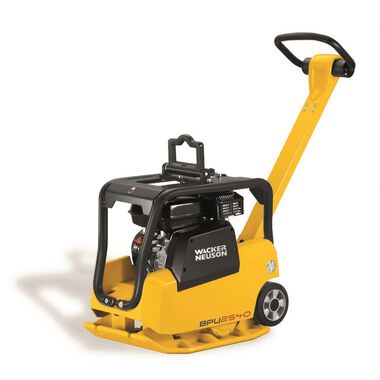
To safely and effectively provide instruction on the inspection and proper use of plate compactors
II. Definitions
Standard PPE – High Viz Garment, Hard Hat, Z-87.1 Safety Glasses, Gloves, Pants, Work Boots
III. Process
NOTE: Work instruction does not supplement the manual. For specific instructions for the exact model please refer to the owner’s manual.
A. Potential Hazards
- Lethal exhaust gas hazards
- Explosive fuel hazards
- Burn hazards
- Respiratory hazards
- Accidental starting hazards
- Eye and hearing hazards
- Rotating parts hazards
B. PPE
- Standard PPE
- Hearing Protection
- Respiratory Protection – Recommended
C. Inspection
- Check the air filter for dirt and dust. If air filter is dirty replace air filter with a new one a required.
- Check carburetor for external dirt and dust. Clean with dry compressed air.
- Check fastening nuts and bolts for tightness.
- Check engine oil level while the compactor is on secure level ground with the engine stopped.
- Remove the dipstick form the engine oil filler hole and wipe clean.
- Insert and remove the dipstick without screwing it into the filler neck. Check the oil level shown on the dipstick.
- If the oil level is low, fill to the edge of the oil filler hole with the recommended oil type.
- Visually inspect to see if fuel level is low. If fuel is low replenish with unleaded fuel.
- When refueling, be sure to use a strainer for filtration. Do not top-off fuel. Wipe up any spilled fuel immediately.
- To inspect the V-belt, remove the four bolts that secure the belt cover to the frame.
- Visually examine the V-belt and determine if it is fully of tiny cracks, frayed, has pieces of rubber missing, is peeling or otherwise damaged.
- Also, examine the belt and determine if it is oil soaked or “glazed” (hard shiny appearance on the sides of the belt).
- If the V-belt exhibits any of the referenced wear conditions replace the V-belt immediately.
- Inspect V-belt tension. Correct tension is if the V-belt bends 10 to 15mm when depressed with finger at midway between the clutch and vibrator pulleys.
- Check vibrator oil by placing the compactor horizontally on a flat surface. Make sure the compactor is level when checking the oil in the vibrator assembly.
- Remove the oil plug (vibrator oil gauge). Clean the oil gauge and re-thread back in.
- Remove the oil gauge again and confirm the oil level does not exceed the cross hash of the oil plug. Do not overfill.
D. Use
- Always make sure crane or lifting device has been properly secured to the lifting bail (hook) of the equipment.
- Adjust the handlebar by loosening the wing nut. Turn the grip clockwise to raise the handle or counterclockwise to lower the handle. When the handle bar is raised to the desired height, tighten the wing nut.
Starting the Engine
- Place the engine fuel valve lever to the “On” position.
- Move the throttle lever to the idle position.
- Place the choke lever in the “Closed” position if starting a cold engine.
- Place the engine On/Off switch in the “On” position.
- Grasp the starter grip and slowly pull it out. The resistance becomes the hardest at a certain position, corresponding the compression point. Rewind the rope a little from that point and pull out sharply.
NOTE: Do not pull the starter rope all the way to the end.
NOTE: Do not release the starter rope after pulling. Allow it to rewind as soon as possible. - When the engine starts, release the starter grip and allow the rope to recoil.
- If the choke lever was moved to the “Closed” position to start the engine, gradually move it to the “Open” position as the engine warms up.
Operation
- Once the engine has started, move the engine throttle lever quickly to the operation position.
NOTE: Always move the throttle lever quickly without hesitation, because increasing the engine speed slowly causes the clutch to slip. - The direction control lever allows the machine to be moved either backward or forward. When the direction control lever is pushed forward, the machine moves forward. When pulled backward, the machine moves backward.
- When the direction control lever is in the neutral position, the machine vibrates staying at the same location.
NOTE: Never stop the engine suddenly when working at high speeds. - Compactor traveling speed may drop on soils when contain clay, however there may be cases where traveling speed drops because the compaction plate does not leave the ground surface easily due to the composition of the soil. To rectify this problem do the following:
- Check the bottom plate to see if clay or equivalent material has been lodged in the plate mechanism. If so, wash with water and remove.
- Remember the compactor does not work as efficiently on clay or soils that have a high moisture content level.
- If the soil has a high moisture level, dry soil to appropriate moisture content level or carry out compaction twice.
Stopping the Engine Normal Shutdown
- Move the throttle to the idle position and run the engine for three minutes at low speed.
- Place the engine On/Off switch in the Off position.
- Place the fuel shut-off lever in the off position.
Emergency Shutdown
- Move the throttle lever quickly to the idle position, and place the engine On/Off switch in the Off position.
E. Maintenance
- Clean machine as necessary.